Only at Pops
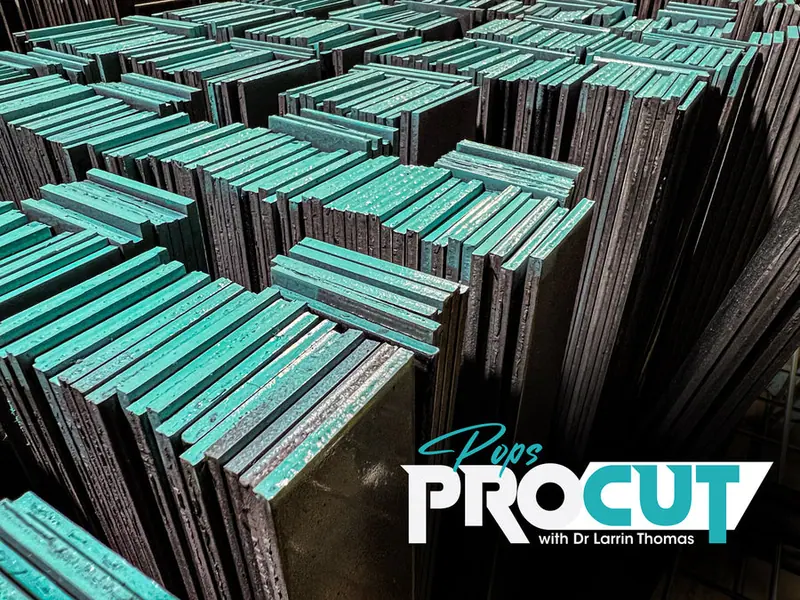
Pops ProCut steel
A collaborative design between Dr. Larrin Thomas of Knife Steel Nerds and Pops Knife Supply.
Can carbon steel be exciting?
The balance between toughness and edge retention.
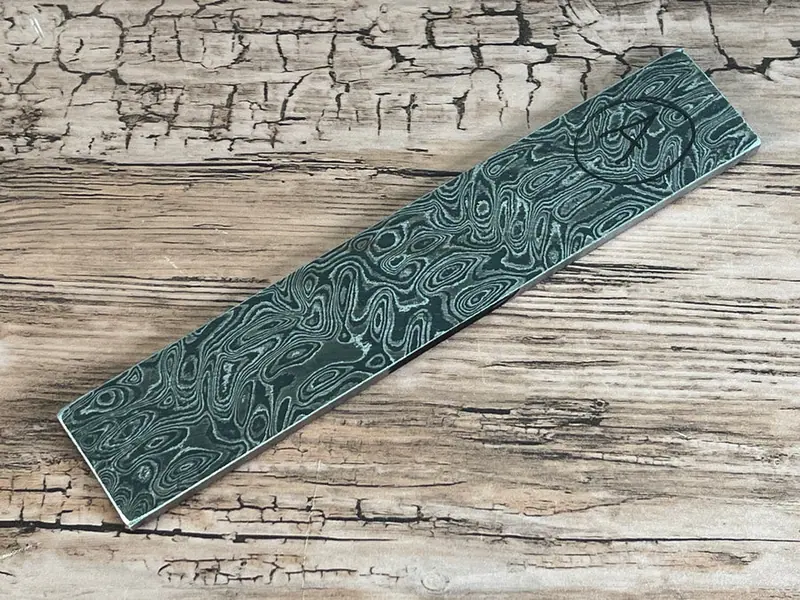
ProCut is extremely forgiving to heat treat, with exceptional hardness and an ultra-fine grain structure. It’s stable in the quench and easy to work and grind, even at higher hardness. It also stands in for 15N20 in high-performance Damascus.
C.866Si.215Mn.352Cr.24Ni1.99V.23W1.23
- Vanadium and tungsten carbides pin the grain, so it resists grain growth even when overheated
- Most quench oils work thanks to high hardenability
- Forge or stock removal. Thermal cycling only needed if you forge
Heat treatment
All steels ProCut heat-treat recipe
Pops ProCut
Forging and Thermal Cycling
These steps are recommended for those forging ProCut. Thermal cycling is not required for stock removal makers.
Forging Temperature: 2200°F (1200°C). As with other steels, overheating or forging too cold can lead to cracking.
Normalizing: 1650°F (900°C) 10-15 minutes, air cool.
Annealing: 1350°F (730°C) 30 minutes, cool at 100°F/hr to 1100°F (50°C/hr to 595°C). Alternatively, heat to nonmagnetic and slowly cool, such as in vermiculite.
Furnace Heat Treatment
Austenitizing: 1500°F (815°C) for high wear resistance, 1650°F (900°C) for high toughness. Soak for 10-15 minutes prior to quenching. More carbide is retained at the lower temperature for edge retention.
Quenching: Most oils can be used with ProCut due to its high hardenability.
Cryo and Cold Treatments: Dry ice or liquid nitrogen is optional and will add 0.5-2 Rc.
Tempering: 300-400°F (150-200°C) for high hardness and edge retention, 450°F (230°C) for high toughness. Temper twice for 1 hour each time, cooling to room temperature between each tempering.
Forge Heat Treatment
The vanadium and tungsten carbides in ProCut “pin” the grain boundaries, which means grain growth is avoided even at relatively high temperatures. The controlled carbon content also means that overheating does not lead to a drop in toughness at those temperatures.
Austenitizing: Heat to “one shade brighter” than non-magnetic. Steel that is normalized and annealed first can be quenched from temperatures as low as non-magnetic.
Quenching, Cryo, and Tempering: See the furnace heat treatment section.
Put it to work
ProCut & matching gear

Knife supplies by knife makers
Ready to try ProCut?
Order bars online or call and we’ll help you choose thickness and length for your next build.
(678) 889-5160